General News
26 April, 2025
VETERANS' VOICES: David Morien Watkyn Edwards
David Morien Watkyn Edwards served in the Australian Army. David was born on 29 April 1920 in Horsham, Victoria.
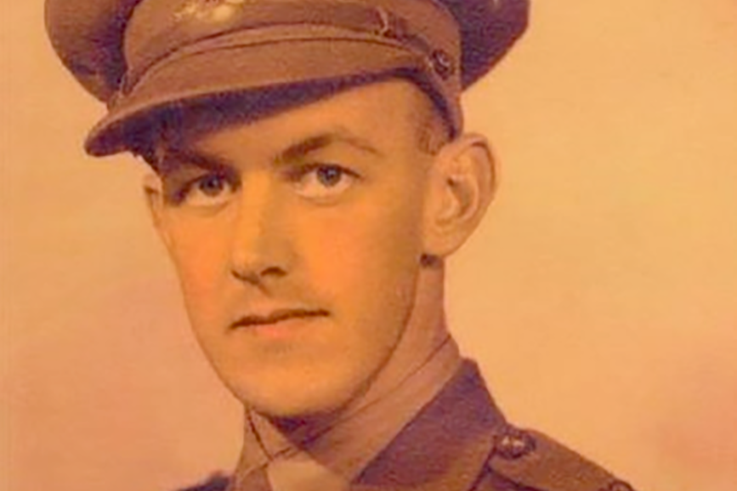
Date of Enlistment was 17 June 1942.
His locality on enlistment was Lubeck, Victoria. David enlisted at Bagot, Northern Territory. His Service Numbers were VX89359 (V56416).
His next of kin was A. Edwards. David was discharged on 4 January 1946.
His rank was Lieutenant. His posting on discharge was 7 Infantry Battalion AMF.
During Covid-19 restrictions it did not stop Beerwah and District RSL Sub-Branch member David Edwards from celebrating his 100th birthday.
The Sub-Branch President John Nisbett dropped by to wish David well from a safe distance.
David was born in Horsham, Victoria, he joined the Army in 1942.
His 7th Battalion trained at several camps in Victoria and moved to Darwin once mobilised for war service.
They were enroute when the northern capital was first bombed.
The Battalion remained in Darwin for 18 months.
After intensive pre-deployment training at Atherton Tablelands, the battalion was deployed to Bougainville in 1944 and remained there at various locations until the end of the war.
David, transitioned as a Lieutenant in 1946.
After the war, David returned to his pre-service job at the Bank of New South Wales (Westpac) in Victoria and Queensland until his retirement.
He attributed his longevity to good genes, remaining active and having many interests outside of work.
The 7 Battalion (Mount Alexander Regiment) was raised as a Militia unit in Mildura in the presence of many distinguished members of the ‘original’ 7th Battalion AIF and wore its colour patch.
It also carried the Battle Honours of its predecessor on its Regimental Colours.
At the commencement of the Second World War, like other Militia units, the 7th volunteered en masse for overseas service but was rejected on grounds that it was needed for the defence of Australia.
Many of its soldiers volunteered for the 2nd AIF and left the unit.
From early October the Militia were called up in two drafts for 30 days training.
This was repeated in early 1940, this time for 90 days.
Militia units were brought up to strength with men conscripted for service.
Most of those called-up and allocated to the 7th were from the Sunraysia district, but others also came from Nhill, Hopetoun, Warracknabeal, Rainbow, Jeparit, Donald, Murtoa, Minyup, Rupanyup, and Horsham.
There were also some from Maryborough and Kyneton.
During 1940 the battalion held a number of training camps, first at Mt Martha on the Mornington Peninsula, then Belcombe,
The battalion trained many soldiers and spent much time at its camp at Nagambie, near Seymour, in Central Victoria.
At the outbreak of war the Militia were put on war alert and became the training organisation for fit men in their twenties called-up and called ‘Universal Trainees’.
When Japan struck, the battalion dug in, in a defensive position in Dandenong area as part of the defences of Melbourne.
However, the battalion was needed elsewhere and in began moving north in mid-February 1942.
The 7th arrived in Darwin on 25 February.
The Japanese bombed the town throughout the year and the battalion got its first taste of action.
It was also in Darwin that the 7th joined the 23rd Brigade.
The brigade had been part of the 8th Division but, when two of its battalions were captured on Ambon and Timor, it was reformed with Militia units.
The 7th joined the brigade's other battalions - the 8th and 27th.
The battalion received the designation 7 Australian Infantry Battalion (AIF) having reached the necessary 75% of its strength being AIF (and thus volunteering for overseas service).
in 1944–1945.
, they took part in the fighting in the central sector of the island in the last months of the war.
Following the end of hostilities, the battalion was once again used in the garrison role before being returned to Australia and disbanding in early 1946.
The brigade spent a year-and-a-half in Darwin.
In April 1943 the 7th was relieved and returned to Melbourne, via Adelaide, for some well-earned leave.
In November, the battalion again headed north, this time to the Atherton Tablelands for intensive training in November 1943. However, the 7th was destined for more garrison duties.
In April the 7th sailed for New Guinea, landing at Lae.
In April 1945 it was deployed to Bougainville and commenced operations against the Japanese in June.
As part of the Bougainville campaign, the 23rd Brigade relieved the American garrisons on the Outer Islands.
The 7th's role was to defend the airfield and conducted surveillance of the surrounding islands occupied by the Japanese.
To escape the boredom and monotony, volunteers from the brigade worked as crews on American PT boats, raiding Japanese-occupied islands in New Ireland and New Britain.
In 1945 the 23rd Brigade moved to Bougainville, becoming responsible for the Central and Northern Sectors.
In April the 7th left the Outer Islands and moved to Torokina, the Australian base on Bougainville.
In June the battalion began moving along the Numa Numa Trail, in the Central Sector, to Pearl Ridge where they relieved the 27th Battalion.
Under the leadership of Lieutenant Colonel Harry Dunkley, the 7th dominated the Japanese.
From 7 June to 15 August the battalion captured 25 Japanese positions, including Wearne's Hill, Base Point 3, Tokua, and Sisivie.
In September, with the war over, the 7th returned to Torokina and was transferred to Fauro Island the next month to helped guard the Japanese.
The Japanese were concentrated on Fauro so they could be repatriated back to their country.
The ranks of the 7th gradually thinned, as men were discharged, transferred, or volunteered for the occupation of Japan.
By the end of February 1946 the last of the Japanese had left Fauro and the remnants of the 7th returned to Australia in March.
The battalion was disbanded on 10 May 1946.
Thirty- five men of the battalion died on active service.
Its present day, successor is now designated as 8th/7th Battalion, Royal Victorian Regiment, an Army Reserve battalion headquartered at Hawthorn, Victoria.
During its service throughout the war the battalion lost 35 mem killed on active service, with a further 50 men wounded. Members of the 7th Battalion were awarded the following decorations. 1 DSO, 1MC, and 16 MIDs.
With thanks: Sally Bertram, RSL Military History Library. Contact Sally at sj.bertram@hotmail.com or call 0409 351 940.
