General News
28 June, 2025
VETERANS' VOICES: Helena ‘Trixie’ Hettrick Chadwick
Helena Hettrick (known as ‘Trixie’) Chadwick appears on the backing card photo of the limited-edition $50 badge for Anzac Day 2025.
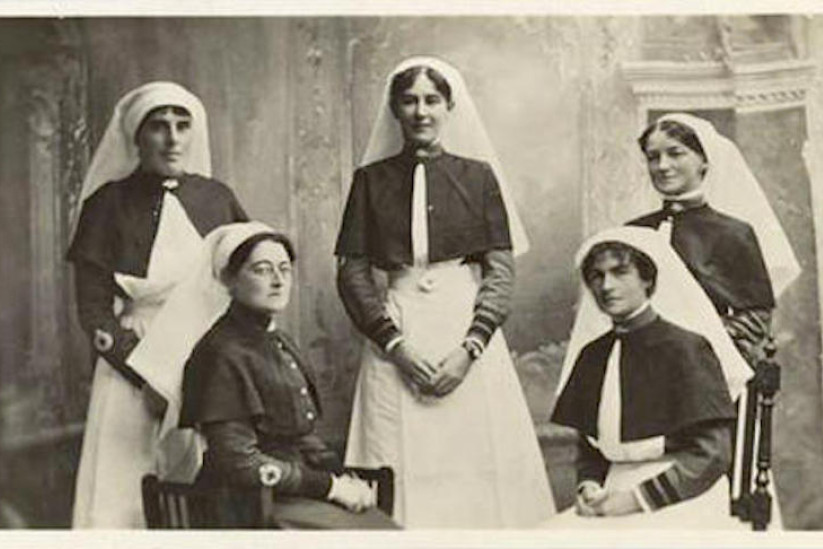
The card is from a studio portrait of the matron and four sisters of the Australian Army Nursing Service (AANS).
Matron Ethel Gray is seated in the front left of the portrait.
The other nurses are Trixie (sitting right), Laura Cumming Pratt (standing right) and Emily Mills and Marguerite Mills (whose exact positions in the group are unknown).
A sixth nurse, Ruby Gourlay Kidd, was ill in hospital when it was taken.
The six women left Australia aboard Osterley to prepare for the opening of 1 Australian Army Hospital (AAH) on June 4 1915.
The design of the badge itself features two World War I ‘Nurses of the Great War 1914-1918’.
Trixie Chadwick was born at Pleasant Creek, Stawell, in 1879.
She was the second daughter of Joseph Chadwick and Sarah Ann (née Wainwright) of London House, Main Street, Stawell.
Trixie was a Royal Victorian trained nurse.
Trixie trained at the Melbourne General Hospital.
In 1907 she was one of 29 listed nurse graduates from The Melbourne.
She served there for three years and obtained a Melbourne Hospital and a Royal Victorian Trained Nurses Association (RVTNA) certificate.
Trixie enlisted on February 10 1915 as sister in the Australia Imperial Forces (AIF), as part of the Australian Army Nursing Service (AANS).
She was 36 years of age.
On arrival in England she was detached for duty with No 1 Australian Auxiliary Hospital (No1 AAH) Harefield, ex 1 Australian Convalescence Depot, England.
In early 1915 Matron Ethel Gray and five trained nurses (of whom Trixie was one), with the assistance of a medical superintendent, servicemen and four orderlies, were selected to establish Harefield Park as a military convalescent hospital.
It was used as No 1 Australian Auxiliary Hospital until January 1919.
Although originally it was estimated that the house would accommodate 50 soldiers under winter conditions and 150 during spring and summer, at the height of its use it accommodated more than 1000 beds and had a large nursing and ancillary support staff.
In 1916 Trixie was serving at No 1 Australian General Hospital (AGH) at Rouen, France.
On January 17 1917 she was serving again at No 1 Australian Auxiliary Hospital, London, when she was transferred to Royal Victoria Hospital, Netley, for duty.
She was attached to 2 Australian Auxiliary Hospital (2AAH) Southall on July 28 1917.
On August 12 1917 Trixie was posted overseas to 1 Australia General Hospital (1AGH) France from 2 Australian Auxiliary Hospital (2 AAH) Southall.
She went on leave to the United Kingdom on February 27 1918 from Rouen, France.
When her leave finished, Trixie returned to her unit on March 15 1918.
On March 28 1918 as a sister in the AANS, Trixie was posted to 3rd Australian General Hospital (3AGH) from 1st Australian General Hospital (1AGH) ex Nurses Home Abbeville.
The following day, March 29, Trixie proceeded to Boulogne, France.
She reported for duty at 3 AGH at Rouen, France, on March 30 1918.
On June 26 1918 she was posted to 2 Australian Casualty Clearing Station (2ACCS) for duty, ex 1 AGH France.
As a casualty clearing station, it was a small hospital located near vital communication hubs, receiving wounded from field ambulances.
It functioned as a hospital, an evacuation centre and a way to quickly assess and return soldiers with minor wounds to duty.
No 2 Australian Casualty Clearing Station (2ACCS) had been opened at Trois Arbres near Bailleul in the second army on July 29 1916 and was staffed with nurses from No 2 Australian General Hospital.
2ACCS was located in a front area, meaning it was closer to the front lines than general hospitals.
It provided medical support – including initial treatment and triage – before soldiers were evacuated further back to larger hospitals.
On August 14 1918 Trixie reported for duty at 2 AGH Wimereux, France.
From there she was posted for temporary duty on the 26 Ambulance Train (AT) on September 18 1918.
During World War I, No 26 Ambulance Train was a vital part of the medical evacuation system, transporting wounded and sick soldiers from the front lines to hospitals, and a narrative account by Sister H Chadwick is available in the Australian War Memorial collection.
According to Sister Chadwick, ambulance trains were used to transport wounded and sick soldiers from the front lines to casualty clearing stations, then to base hospitals and ultimately to evacuation ports.
In the early stages of the war, ambulance trains were makeshift, using ordinary French rolling stock or basic transport wagons.
Over time they became more sophisticated, with dedicated ward cars, dining cars and even separate compartments for infectious cases.
A typical ambulance train could carry around 400 to 500 patients, many of whom were in critical condition.
The trains were staffed by medical officers, nurses and orderlies.
A main destination for the ambulance trains was the large military field hospital complex near the French town of Étaples.
On September 22 1918 Trixie was on duty in the field.
She returned to do further duty at 2 AGH Wimereux on March 3 1919.
Helena took leave in Paris on March 12 1919.
On returning from leave on March 17 1919 she reported for duty at AAH, London.
On April 2 1919 she transferred and was taken on strength to AIF Headquarters London for non-military employment.
This was an AIF vocational education scheme for non-military employment training before embarkation for RTA demobilisation.
Trixie was granted leave from June 2 to July 2 1919 to enable her to learn to drive by attending The British School of Motoring at 516 Coventry Street, Piccadilly, London.
On July 13 1919 Trixie was returned to Australia aboard Persic on duty as part of the vessel’s nursing staff.
She disembarked to 3 Military District (Victoria) on August 29 and on December 14 1919 was discharged from the AIF.
Trixie did not marry.
She lived in Armadale until her death on July 15 1967.
Trixie is buried at Springvale Botanical Cemetery, in the Banksia Rose Garden 2, Bed 2, Position 132.
Trixie Chadwick received the British War Medal No 9601 and the Victory Medal No 9513.
With thanks: Sally Bertram, RSL Military History Library. Contact Sally at sj.bertram@hotmail.com or call 0409 351 940.