General News
14 June, 2025
VETERANS' VOICES: John Arthur Apps
John Arthur APPS was born in 1896 in Sussex, England, the eldest of five children of Robert and Lucy (née Stone) Apps.
At the age of 19, he enlisted at Horsham in January 1916, giving his address as Edenhope and his occupation as labourer.
John was assigned as a trooper in the 13th Light Horse Regiment, 8th Reinforcements, in the Australian Imperial Force (AIF) and allotted service number 1700.
The 13th Regiment embarked from Melbourne on board HMAT A6 Clan Maccorquodale on May 6 1916 and arrived at Alexandria, Egypt.
In Egypt the 13th Light Horse Regiment moved to the Suez Canal, taking part in its defence.
After the evacuation of the Gallipoli Peninsula in December 1915, the Light Horse regiments that had been deployed were re-constituted in Egypt, and in March 1916 the Australian mounted troops of the 1st, 2nd and 3rd Light Horse Brigades and the New Zealand Mounted Rifles Brigade were placed together in the ANZAC Mounted Division.
On July 10 1916 he embarked for Marseilles, France, on the transport ship Tunisian.
John subsequently joined the 2nd Anzac Light Horse Regiment.
A week later he was transferred for duty to the 2nd Anzac Headquarters and assigned as an MMP (military mounted policeman) under the command of the assistant provost marshal.
Previously known as the Australian Army Provost Corps, it had been formed on April 3 1916 as the ANZAC Provost Corps.
Upon arrival in France the AIF’s ANZAC provost marshal (APM) adopted many of the practices of the British Military Police who had been on the Western Front for more than 18 months and had honed their skills during that time.
The primary tasks for the Australian military police were battlefield traffic control, security duties, prisoner-of-war handling, investigating service offences, maintaining discipline, running military prisons, protecting the civilian population from acts of violence by soldiers and preventing contact between soldiers and ‘undesirable characters’ such as prostitutes, hawkers and liquor sellers.
The MMP would be sorely tested in later battles and would suffer their share of casualties as a result of shrapnel as they often manned exposed intersections and positions.
It was not until August 1916 that the various MMP elements serving in France were formally absorbed into the ANZAC Provost Corps.
In January 1918 the ANZAC Provost Corps was formally re-designated as the Australian Provost Corps.
Initially when the corps had formed it was intended that the Australian and New Zealand police would formally work together within the same corps; this never formally occurred.
However, it is apparent that the two forces did work closely together.
Indeed, at Gallipoli, Colonel Bowler (NZ Forces) had a mixed force of Australians and New Zealanders as MMP within the Australian and New Zealand Army Corps Headquarters.
Likewise, within the ANZAC Mounted Division in Egypt the MMP detachment was mixed.
From early March 1917 John was transferred back and forward between the Australian and New Zealand units.
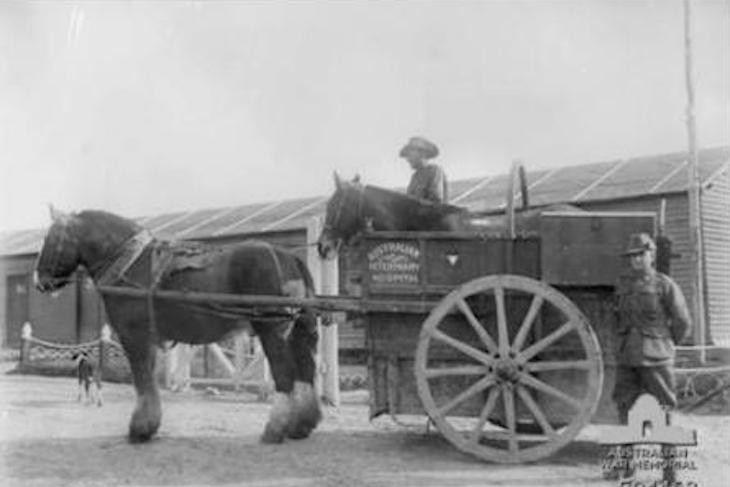
The war ended in November but John was then transferred to the Australian Veterinary Hospital in Calais, France, in December 1918.
Australia shipped some 120,000 horses overseas during the war.
More than 39,000 horses served with the AIF, mostly in Egypt and Palestine with the Australian Light Horse.
No animals used in the war could be brought home due to Australia’s strict quarantine laws, which helped to prevent the spread of animal and plant diseases and pests.
Australians had to decide what to do with more than 20,000 horses in the Middle East and Europe.
In France, Belgium and England, the horses were sold to locals.
In Egypt, donkeys and camels were more popular work animals, and many soldiers feared their horses might be mistreated.
Commanders decided to give some horses away.
Many horses were sold to the British Indian Army, which had purchased many horses from Australia before the war.
John stayed with the Australian Veterinary Hospital until July 17 1919, when he sailed from Liverpool, England, to return to Australia on the ship Mahia.
He was officially discharged on August 31 1919.
On his return from overseas John travelled about looking for employment, mostly between Victoria and New South Wales.
He found most opportunities in work as a labourer and farmhand.
John did not marry and there were no known relatives in Australia when he died at Horsham Railway Station on January 20 1965.
He was buried in the returned soldiers’ section of Horsham Cemetery and awarded a grave site from the Office of Australian War Graves for his service.
With thanks: Sally Bertram, RSL Military History Library. Contact Sally at sj.bertram@hotmail.com or call 0409 351 940.