General News
22 January, 2025
Newton doing her part during Grampians bushfire
Rainbow's own Courtney Newton was one of the many deployed with Forest Fire Management Victoria (FFMVic) to help contain the devastating Grampians bushfire that broke out at Yarram Gap just before Christmas.
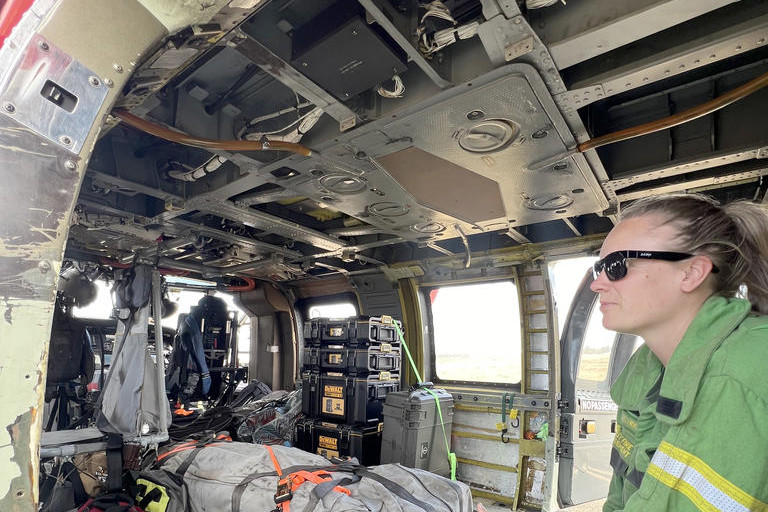
Ms Newton is a Field Operations Supervisor at Rainbow WorkCentre and has previously worked as a Project Firefighter (PFF) with Parks Victoria in 2021, before transitioning to the Department of Energy, Environment and Climate Action (DEECA).
Her first taskforce dates back to 2022 where herself and 20 members were a part of a planned burning in the Little Desert National Park.
This included a taskforce leader, operation officers, crew leaders and crew.
"While we were doing backburning, I felt a strong sense of urgency and importance to complete the backburning to a high standard, and felt very proud of our team that the fire didn’t escape the western sector control line we had worked on," Ms Newton said.
However her first fire taskforce was to the Mount Staplyton fire in February last year.
Ms Newton was first deployed to the Yarram Gap fire for four night shifts starting from December 20.
"After a 10-hour break we travelled home at night on Christmas Eve," she said.
"I had Christmas day off as a rest day, then I was on readiness on Boxing Day at the Linga airbase for the Mallee District.
"Readiness at an airbase usually involves an airbase manager, four mixers and loaders, aircraft with air observers, air attacks supervisors and pilots."
That same afternoon four members from the Mallee were asked to travel to Stawell that night to complete five shifts.
"We worked the shifts as mixers and loaders for the bombers based at Stawell and then travelled home on New Year's Day," Ms Newton said.
Over the time spent deployed, Ms Newton and her crew carried out tasks such as backburning and patrolling on the western sectors near Mirranatwa, Grampians Valley Lookout, which is 20 minutes from Dunkeld.
"A dozer was working a few kilometres in front of us to strengthen the control line. We were burning off so the fire had less chance of jumping over that control line," she said.
"Our mixing and loading deployment required us to load the SEAT bombers (aircraft that waterbomb fires from the air) with retardant when it was required, and mix retardant batches when supply was getting low."
With her qualifications and training in crosscut and trim chainsaw accreditation, retardant mixer and loader, ADT mixer airbase manager (mentee), crew leader and tractor tickets, Ms Newton was able to apply it to her deployment.
"I did my crew leader course in August 2024, so I was able to apply all that knowledge I gained and put it into practise to ensure I was able to report fire behaviour to my Operations officer and always look after my crew’s safety," she said.
"Also being a Retardant Mixer and loader helped our deployment to the Stawell airbase.
"We were able to work with local mixing crew and became familiar with how their mixing shed worked. All crew we worked with had great personalities and were very informative. Especially when some had their own homes under threat.
Looking back on the experience, Ms Newton had nothing but positive words to say about it.
"I really enjoyed how much the taskforce came together as a team so quickly, we are all there for the same reasons, we want to help protect the communities and everyone was willing to share knowledge and skills to achieve the same goals," she said.
"Every deployment has brought so much growth and experience to everyone involved.
"It’s a wholesome feeling seeing new and experienced crew sharing information and stories with each other and uniting as a team."
Ms Newton said the nightshift taskforce was just short of a 50/50 female to male ratio.
"It was so amazing to see," she said.
And as with any task comes its challenges, which these crews most certainly faced.
"The hardest part was trying to fall asleep in basecamp during the day and when it was warm and very windy weather," Ms Newton said.
"Once I got into a routine and found my earplugs, I was fine.
"We were very thankful though for all the crew at basecamp that were doing everything they could possibly do to help us rest and then get us going again."