General News
29 July, 2025
Rural groups rally to protect farms from renewables, mining
Almost 300 people braved the Horsham winter chills to hear about the impact of renewables and mining in the broader community, the future of local businesses, and food production from guest speakers at an information forum on Wednesday evening.
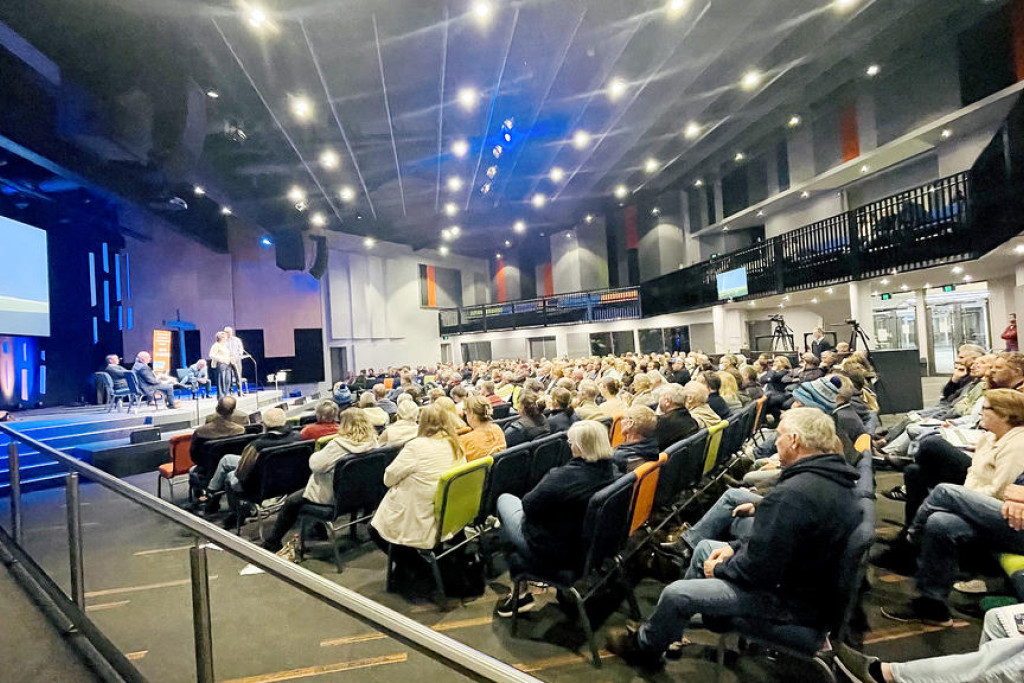
Speakers included the engineering field, an economist, two property owners, and a business owner.
President of Wimmera Mallee Environmental and Agricultural Protection Association, Ross Johns, opened the meeting with the announcement that attendees were there to witness the funeral of poor government policy, which brought laughter and cheers from the floor.
Guest speakers covered topics from the lack of documented evidence worldwide to rehabilitate agricultural land after mining, the economic impact surrounding renewables, poor government policy on the future of agriculture, changing legislation to protect property owners the ***Paris Agreement 2:1 (b) that states practices to lower emissions and address the green House effect should be done .......' in a manner that does not threaten food production.'
Dr John Russell, a retired agricultural engineer, critiqued the WIM Resource PL Trial findings at the proposed Avonbank Mine site in Dooen.
"I have conducted test sites there, and I have searched worldwide for proof that soil can be rehabilitated successfully after mining, and I can find no such proof," he said.
He made his findings available in print on the night after giving an extensive presentation about soil composition and what he said are the unproven claims by mining companies that soils can be returned to produce crops of the same or similar yield and quality as they did before a mining operation.
The hope that mining and renewable projects would bring jobs and wealth to the region was explained by Economist Bill Malcolm as "the unknown because it [the mine] has not happened yet to be able to claim that no one would be worse off and at least one person would be better off, which is the definition of economics, " he said.
He described the jobs a mine would provide as no more and no less.
He said it would not provide one additional job, because it [ the industry] just moves the same people around from site to site.
"Bad decisions come home to roost," he said.
"Economics eventually beats politics."
Third-generation grain farmer from Rupanyup, spokesperson for farmers fighting renewables on agricultural land, Andrew Weidermann, while he leads the Dunmunkle Land Protection Group, also referred to the Dooen-based Mine Free Wimmera Farms Incorporated group and the huge impact the proposed Avonbank Mine would have on the farming community at Dooen and the rural city of Horsham.
"I am worried about Horsham businesses, I am worried about the water that will be used to hold down the dust from the mine, 24x7 for 36 years. It doesn't sound like a good idea to me," he said.
"Horsham businesses will lose employees to the mine and have to pay higher wages to replace them. This, in turn, increases the cost of your products and services.
"Mining companies talk about the jobs they'll create, but I think we'll lose more."
Local businesswoman Andrea Cross explained that she had initially lodged two favourable submissions about the proposed Avonbank Mine with the government.
She later felt she had done the wrong thing by her community, her family, and her friends.
It wasn't until people who had been her friends approached her that she realised the impact the proposed mine at Dooen would have on them and the wider Horsham community.
With the VNI-West transmission line project aiming to cross many kilometres of farmland that has the objection of every farmer and property owner in its path, committed to not allowing entry to their land, the government is seeking to change legislation to give renewable company owners the right to enter with hefty fines of $12,200 if the owner does not comply.
Additional fines apply if an owner refuses to identify themselves as the owner, and further fines if they display signs on their property against the project.
Sheep farmer Ben Duxson, three years into his fight to protect his farm, said turning prime food-producing land over to renewable and mining projects did not make sense to him.
"The government has stated that 70 per cent of agricultural land in Victoria has been earmarked for renewables," he said.
"And if you overlay mining on top of that, what's left?
"Horsham needs to learn they're facing a government-induced train wreck," he said, referring to the proposed Avonbank Mine at Dooen."
Farmers who have taken a stand against the transmission line crossing their land will face fines, but Mr Duxson said he and others will continue the fight regardless.
"Our beef is with the government, not with anyone else," he said.
"We are not against the city or metropolitan communities, but we do need their support, and with that support we can continue to provide food and fibre."
Five hundred kilowatt transmission lines across his land will put an end to operating his sheep farming industry using the technology he currently employs, he told the audience.
Mr Weidermann's lasting message to the audience was not to give up hope and not to leave the meeting despondent.
"We are not just standing up here complaining and saying how bad things are; they are bad, but please be confident that we have a plan and we believe in the power of the people in overturning poor government policy," he said.
"We need your support to do that."
Mr Weidermann also leads the recently formed Across Victoria Alliance. An organisation formed by 27 incorporated groups to protect the agricultural industry in Victoria.
Mine Free Wimmera Farms Secretary, Russell Heard, and Media Officer Donna Johns attended the meeting along with many other members of the farming incorporated bodies from the region.
Ms John's family is one of the homes and farms that will be impacted by the proposed Avonbank Mine at Dooen.
The Paris Agreement is a legally binding international treaty on climate change.
It was adopted by 195 Parties at the UN Climate Change Conference (COP21) in Paris, France, on December 12, 2015. It entered into force on November 4, 2016.
The Mail-Times has contacted WIM Resource, Astron Ltd, and Vic Grid for comment.


