General News
24 November, 2025
Spring rains bring higher risk of haystack fires
A spate of haystack and hayshed fires has been a reminder for farmers to take extra care to prevent haystack fires.
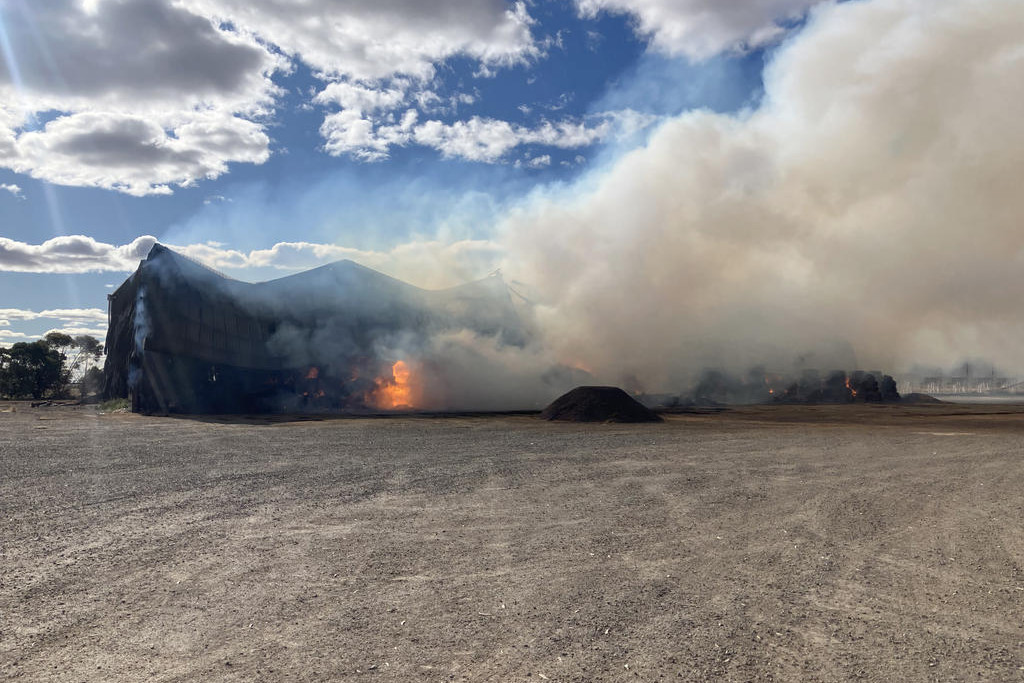
Hay season has been in full swing across the west and north-west in the past weeks, and the warning comes after three significant haystack fires in the north-west of the state, where thousands of bales were lost.
On the morning of Saturday, November 8, CFA responded to a haystack fire at Sullivan Rd, Patchewollock, north of Hopetoun and the very next day, to a hayshed fire in Towaninny South, near Dumosa, at about 1pm.
In the latter case, firefighters arrived at a large hay shed well alight, impacting over 1000 bales.
The incident was handed back to the landowner within a few hours, but bales can burn for days, producing significant smoke.
Crews also responded to major hay fires last week in Robinvale and Bagshot.
Between June 30, 2024, and July 1, 2025, CFA responded to 73 haystack and hay shed fires in regional areas.
Haystack fires are often caused by spontaneous combustion when hay is baled with excess moisture.
High moisture levels, combined with the compact nature of hay bales, can create internal heat, leading to ignition.
With good spring rains in the region, such as the 54.6 millimetres in Horsham in October, which was above the average of 34.5mm, the warnings are timely.
CFA chief officer, Jason Heffernan, reinforced that early preparation and proper storage are essential in reducing the risk of haystack fires.
“Farmers who have decided to carry on with hay production need to be extra vigilant this year to make sure conditions are right for making hay and for the future storage and transport of the product as well,” he said.
“Hay fires are a real threat to properties and stock in farmland areas. Whether you’re a seasoned hay grower or switching to hay this year, it’s important to take care of your hay and crops this fire season.
“Use technology to monitor your haystacks regularly, temperature probes can provide an early warning, detecting heating hay and alerting.”
While in the past, farmers relied on the time-tested method of using crowbars inserted deep into the stack for two hours to check temperatures, along with watching for condensation on the shed roof and mould growth, more recently, technology has also employed sensors to send alerts via apps on phones and watches.
Apps like Haytech and MyHay are specific to bales, but more generic apps such as iSocket have also been used for temperature monitoring, while others, such as Hay Mate, help reduce risk during harvest.
Mr Heffernan added that it wasn’t just about your own assets, but also about others in the community.
"Haystack fires can have far-reaching effects beyond individual properties, impacting neighbouring farms and emergency services,” he said.
“Make sure you store your hay in separate stacks or in sheds away from farm equipment and other buildings to prevent the spread of fire.”
For more information, visit CFA’s website at bit.ly/449CxmT or contact your local CFA brigade for advice on haystack safety.