General News
21 June, 2025
William Leslie Barnett and William Norman Barnett
William Leslie Barnett was the father of William Norman Barnett, who served in World War II.
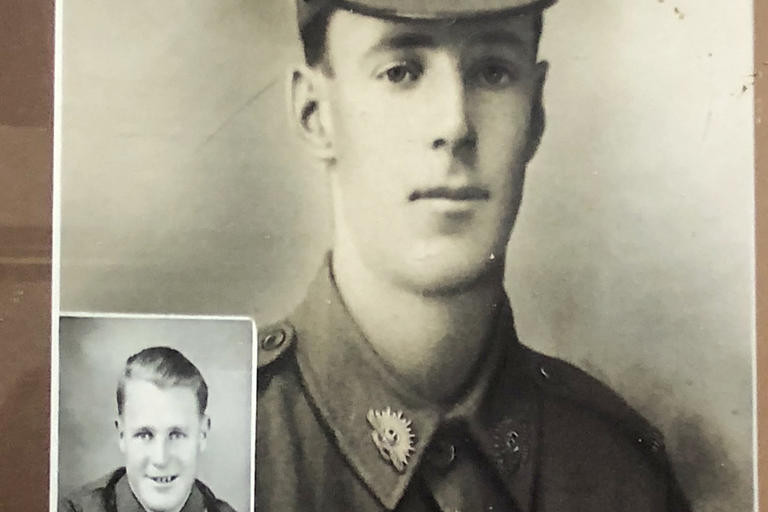
William Leslie was born in Horsham, the son of Henry Barnett of Green Park, Horsham.
He spent two years in the senior cadets in Horsham.
William was a Labourer at aged 18 years of age when he enlisted on January 6 1916 at Broadmeadows and was allocated service number 1798.
He underwent signal school before leaving Australia and embarked on with 58th Infantry Battalion on HMAT Euripides from Melbourne on April 4 1916.
William underwent more training in England.
He was promoted to Driver on August 21 1916.
William proceeded to France in November 1916 to join 60th Battalion.
In January 1917 he transferred to 14th Australian Army Serve Corps.
William would likely have seen service on the Somme during the assaults on the Hindenburg Line in February and March 1917, at Bullecourt in April and May, at the Battle of Messines from May to July, in the Third Battle of Ypres (which included the Battle of Polygon Wood and Passchendaele), as a reserve at the Battle of Cambrai (from late 1917 to early January 1918), at the defence of Amiens against the German offensive of March 1918, at the assault on Hamel (July 1918) and at the final offensives against Mont St Quentin and the Hindenburg Line in August to October 1918.
William returned to Australia in 1919 and was discharged from the army in April 1920.
William was only 33 years of age when he died after a lengthy illness.
The war had taken its effects on him and his health was impaired as a result of his service.
He left a sorrowing widow, children William and Wesley, his mother and a brother to mourn his loss.
The Horsham Times reported on September 8 1931 that deep sympathy had been extended to the bereaved family and relatives.
William Leslie Barnet was interred at Horsham Cemetery.
As a sad footnote, when William died his wife was pregnant with their third child and gave birth to daughter Margaret in October 1931.
[CROSSHEAD]Division trains
William served mostly in France attached to 14 Company, 4 Division Train.
The 14 Company 4 Division (and Brigade) Trains were logistic support and supply units under the command of the division to which its numeric designator corresponded.
Without logistics there could be no combat.
Each unit was responsible for the storage and delivery of supplies to the front, ranging from ammunition and grenades to food and drink as vital components of the combat power of the army.
The basic tasks of train companies were to carry baggage and resupply food, forage and water for the headquarters and units of the division.
The means of delivering food was then usually by horse-drawn wagon or by foot when closer to the lines.
In addition, the train companies supported division units with a wide variety of general tasks such as providing drivers for formation headquarters and field ambulances, carting roadmaking materials and engineer stores, operating snow ploughs, providing transport for postal deliveries, repairing unit equipment, and operating ad hoc pack transport units.
The supply columns and ammunition sub-parks, in addition to their basic tasks, hauled lumber, road metal, ordnance and postal cargo, petrol, quicklime, rails and medical comforts, and provided emergency mass medical evacuation and incidentally filled in as medical assistants at dressing stations,
[CROSSHEAD]William Norman Barnett
William Norman Barnett was born on January 11 1923 in Horsham to William Leslie Barnett and Gladys Ruby (Burrell) Watts.
William Norman had a brother Wesley Gordon Renwick and a sister Violet Gladys (named elsewhere as Margaret).
William went on to marry Catherine Alberta Ruth Dart in 1945 in Victoria.
William died in March 2009 at the age of 86 in Horsham.
William and Catherine are interred in Horsham Cemetery (south 2-c-37).
As a driver, William Norman served in the Australian Army during World War II.
He enlisted on May 11 1943 in the field in Western Australia.
His locality on enlistment was Horsham.
William’s service number was VX139238 and his next of kin on his nominal roll record was Kathleen Barnett.
On February 6 1942 he was taken on strength (TOS) ex Area 7A Royal Park.
During World War II there was a large military camp in Melbourne initially known as Camp Royal Park but later renamed Camp Pell in honour of Major Floyd Pell of 33rd Pursuit Squadron, USAAC.
It tended to be used as a transit camp.
William was transferred from Camp Pell to 10 Training Battalion on February 7 1942.
The 10 Infantry Training Battalion (23 Infantry Training Battalion) was formed in 1942 and based in Balcombe.
It was disbanded in Queensland in 1942 and renamed 23 Infantry Training Battalion.
It trained recruits in the Northern Territory until they were moved to Bathurst.
The battalion finally ended up in Greta, where it saw out the war until being disbanded in 1945.
On March 19 William was transferred to Australian Army Service Corp (AASC) 4 Division from 10 Training Battalion.
William entrained from AASC 4 Division to 5 Military District (MD) on April 18 1942 at 2 Military District (2MD).
From AASC 4 Division, William was detached to 109 Reserve Motor Transport (RES MT) on May 14 1942.
This unit continued with more training and was vital to for the continuation of supply items.
William Norman Barnett was discharged on January 22 1946 with the rank of driver.
His posting on discharge was 2/36 Transport Platoon.
Army drivers of World War II were associated with motorised vehicles, some of which had been maintained, upgraded and used over decades.
Driving was not always highly hazardous as in an organisation so dependent on logistics, military drivers operated all manner of vehicle.
With thanks: Sally Bertram, RSL Military History Library. Contact Sally at sj.bertram@hotmail.com or call 0409 351 940.
